
Magazine article - Circus 1989
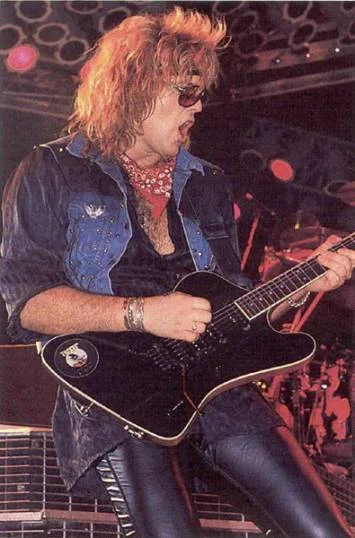
Ratt: Back for more
by Ben Liemer – from Circus Magazine / April 30th, 1989
“Learning to play music shouldn’t be like visiting your parole officer,” Warren DeMartini asserts. Ratt’s lead guitarist, who began taking traditional, classical-style piano lessons at age seven, knows what he’s talking about. After a few years he dropped the unpleasant lessons and began fooling around on his brother’s guitar. Now this was fun --- making noise in the basement, worrying his mother.He has seen Jimi Hendrix’s feed-back-laden flipouts in the movie Woodstock --- and once, his older brother even took him to see the Who in concert (Maybe his brother was an ok guy after all.) Warren was hooked---a bona fide rock & roll junkie.
“No guitar solo has ever sold a song to anybody.” Ratt’s Robbin Crosby
Today, four Lps, one Ep and millions of record sales later, fun remains what Warren and Ratt are all about. And nowhere is this enthusiasm more apparent than in the grooves of Reach for the Sky (Atlantic), the latest platter from DeMartini, Stephen Pearcy, Juan Croucier, Robbin Crosby and Bobby Blotzer.
Yes, after almost a two year break, Ratt & roll is back---the L.A. quintet hit the road in late January with opening act Britny Fox, just about the time Reach was certified gold and heading towards becoming their fourth consecutive platinum Lp.
And to hear lead singer Pearcy talk, he couldn’t sound happier. “I’m ready to go on vacation,” he declares. “This is my vacation, on tour. We can take our [individual] trips to Bora Bora and Hawaii and all these wild places, but for me, vacationing is seeing different people all over the U.S. and the world, touring and playing music.
“We’re talking a long tour,” he continues. “We started New Year’s Eve at the Tokyo Dome in Japan---three shows with Ratt, Bon Jovi, and Kingdom Come. Three days, 50,000 a day. We began in ’89 and hopefully we’ll finish New Year’s Eve in Los Angeles, 1990.”
If Stephen sounds like his batteries are recharged and he’s raring to go, it’s so. For the first time since recording their 1984 multi-platinum blockbuster, Out of the Cellar, Ratt stepped off the non-stop treadmill of album, tour, pre-production, recording, album, tour, etc.
“Everybody surely needed it,” the frontman notes. “The [ Dancing Undercover ] tour was long, it was successful, it worked. I love all the other records but we wanted to sit down and concentrate on what we were gonna do for the new Ratt record. And the time allowed us to do that.”
“It was a breath of fresh air,” agrees guitarist Crosby. “It was an opportunity we’ve never afforded before. We had six or eight weeks between [working with Mike Stone and Beau Hill, Reach’s co-producers]. We had to wait for Beau to finish another project, while we sat with the tape hot in our hands. And a lot of stuff changed quite a bit---we changed the choruses around, changed the titles around.”
“We cut more songs for this record than any other album,” notes Croucier. “We wanted to make it special.” In fact Juan and the Ratt pack completed writing on 21 songs, before recording the basic tracks for 14 with Mike Stone. That number quickly became 15 tunes when Beau Hill and Ratt recorded “Way Cool Jr.,” the Lp’s first single/video.
“Rather than just record it, put it out and [later say], ‘Gee, we could have done this or that,’ on this record we did do that,” Robbin states. “ We did do it all. This is the whole kitchen sink.” Adds Stephen, “We weren’t gonna stop because of a deadline the record company was gonna give us. They knew if they waited, they would get the best from us.”
It’s not usual for an arena-headlining act to take an extended break as Pearcy and Co. have. Ratt’s close pals in Motley Crue are currently in the studio, having taken time to put their house in order. Both bands reassessed their musical directions after receiving criticism from some quarters for successful albums (Ratt’s Dancing Undercover, their rawest sounding to date, and Motley’s Girls, Girls, Girls, their most slick and commercial).
“We got sick of hearing how we’re washed up or how Dancing wasn’t a success at a million and a half units,” Robbin emphasizes. “I’d like to talk to a lot of other artists that didn’t have a million-and-a-half sellers and ask them what kind of a flop that was.”“In the old days, Van Halen only went platinum,” defends drummer Bobby Blotzer. “Their first album kicked ass, but the next few went platinum. And they always did good business live. In 1988 everybody sells two million, [at least] of the top seven or eight bands. You have to be double platinum to be a headlining act. You’ve gotta have one album that’s mega, like Out of the Cellar, Appetite for Destruction, that [makes] you a household name, besides [being a hit] with the kids.”
The time off has served Ratt well---they appear to have their priorities straight, as Pearcy explains: “This is all supposed to be about having fun---not making statements to change the world. I think Robbin had a good point: You know this isn’t the Olympics. You don’t have to get out there and beat everybody up just to prove you’re the hottest band in the land. There’s plenty of space for everybody in every style of music. We’ve pretty much found our place here.
One thing is certain---in 1989, Ratt are more a band than they’ve ever been. “It’s like we’re married to each other,” Juan says. “This was more of a group effort than ever before. Everybody had ideas,” echoes Pearcy. A quick check of the songwriting credits bears out the singer’s statement. On the finished album, Warren and Juan had a hand in seven songs each, Stephen co-wrote nine and Robbin contributed to six.
“We’re trying to feature the band---not one particular player,” Croucier maintains. “What counts is the full package.” Chimes in Crosby,” You can play till you’re blue in the face but no guitar solo has ever sold a song to anybody.”
So as the song on Reach for the Sky goes, what’s the “Bottom Line”? We’ll let Juan have the last word: “You can’t base your happiness and integrity on how many records you sell. It’s music, it’s not just a popularity contest. It’s what you’re saying in your music that’s important---whether the record goes gold or sells 50 million. And really, [once the recording is over], the artist has no control over it. Everybody goes into the studio and does the best they can. And obviously the public is the final judge.”
So far, the judge seems to be signaling approval. And Ratt’s “world infestation,” begun in 1984, continues.